
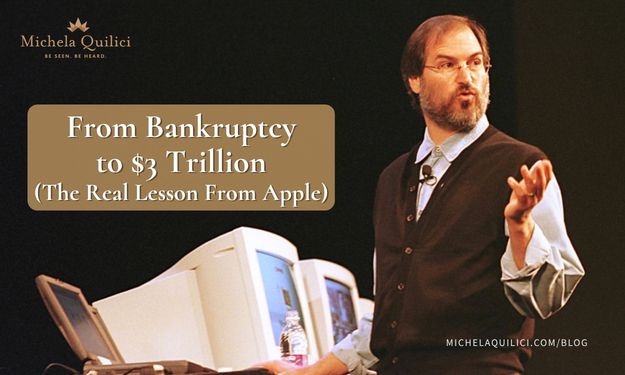
In 1997, Steve Jobs walked back into Apple after twelve years away.
The company was 90 days from bankruptcy.
He spent the first few weeks doing what most incoming CEOs do. He met with the product teams, reviewed the pipeline, walked the floor, and listened to the roadmaps.
Then he called an all-hands meeting, went to a whiteboard, and drew a two-by-two grid.
Four quadrants: …Consumer …Pro …Desktop …Portable
He turned to the room and said something along the lines of: “Here’s what we’re going to do. We’re going to make four great products. One for each box. That’s it.”
At the time, Apple had somewhere north of 350 SKUs.
Jobs killed 70% of them in under a year.
It Wasn’t About Focus
The story that usually gets told about this moment is a story about focus. About the courage to say no.
That isn’t quite what happened.
Jobs wasn’t cutting products. He was diagnosing something deeper.
Apple’s problem in 1997 wasn’t that it had too many products. It was that every one of those products had been built for a different version of the company. Different assumptions about the customer, different assumptions about the technology stack, different assumptions about what Apple was even supposed to be.
The operating system the company was running (its actual internal logic, not the software) had been quietly patched and forked so many times over twelve years that no single strategy could work across all of it.
You could have handed Apple’s team the best strategic plan in the world in 1997 and it would have failed. The underlying operating system couldn’t execute on any coherent plan, regardless of what the plan was.
Jobs’ four-quadrant grid wasn’t a strategy. It was a reset of the operating system.
The Same Pattern, Every Time
I think about this story a lot when I’m sitting across from a founder who’s plateaued somewhere between six and seven figures.
Because the pattern is almost always the same.
They’re bright. They’ve done the work. They’ve hired the coaches, run the frameworks, tested the funnels, adjusted the pricing, refined the offer, built out the team.
Every strategy technically worked, somewhere, for someone. Just not durably for them.
By the time we’re sitting together, they’ve usually diagnosed themselves as either lazy, stuck, or fundamentally missing something everyone else has figured out.
Why the Pieces Don’t Compile
That isn’t the truth of it.
They’re stuck because their business is running on an operating system that was assembled, one prescription at a time, from other people’s playbooks. A funnel from one coach. A team structure from another. A sales script from a mastermind. A pricing framework from a course. A leadership approach from a book they read in 2019.
Each piece was fine in isolation.
Together, they don’t compile.
The founder is running a business built on someone else’s assumptions about who the customer is, how sales should happen, how a team should be structured, how decisions should get made, and how the founder herself should show up.
None of those assumptions were ever calibrated to who she actually is or how her particular business actually works.
You can hand a founder in this position the best strategic plan in the world. It won’t stick.
Adding another strategy on top of a mismatched operating system doesn’t unstick the plateau. It thickens the layer of misalignment.
Diagnosis Before Strategy
The work I do with founders in this position doesn’t start with tactics.
It starts with a diagnostic across the business, the team, the offer, the operations, and how the founder is actually wired to lead. That diagnostic produces a picture of where the current operating system is misaligned with the founder running it.
Then, and only then, we build the strategy.
A strategy built on top of an aligned operating system compounds. One built on top of a misaligned one just becomes the next thing that didn’t stick.
The Real Lesson From Apple
Apple went from 90 days out of bankruptcy in 1997 to the most valuable company in the world.
Jobs wasn’t a better strategist than the people before him. Rather, he was the first person in twelve years to look at the operating system before writing another strategy on top of it.